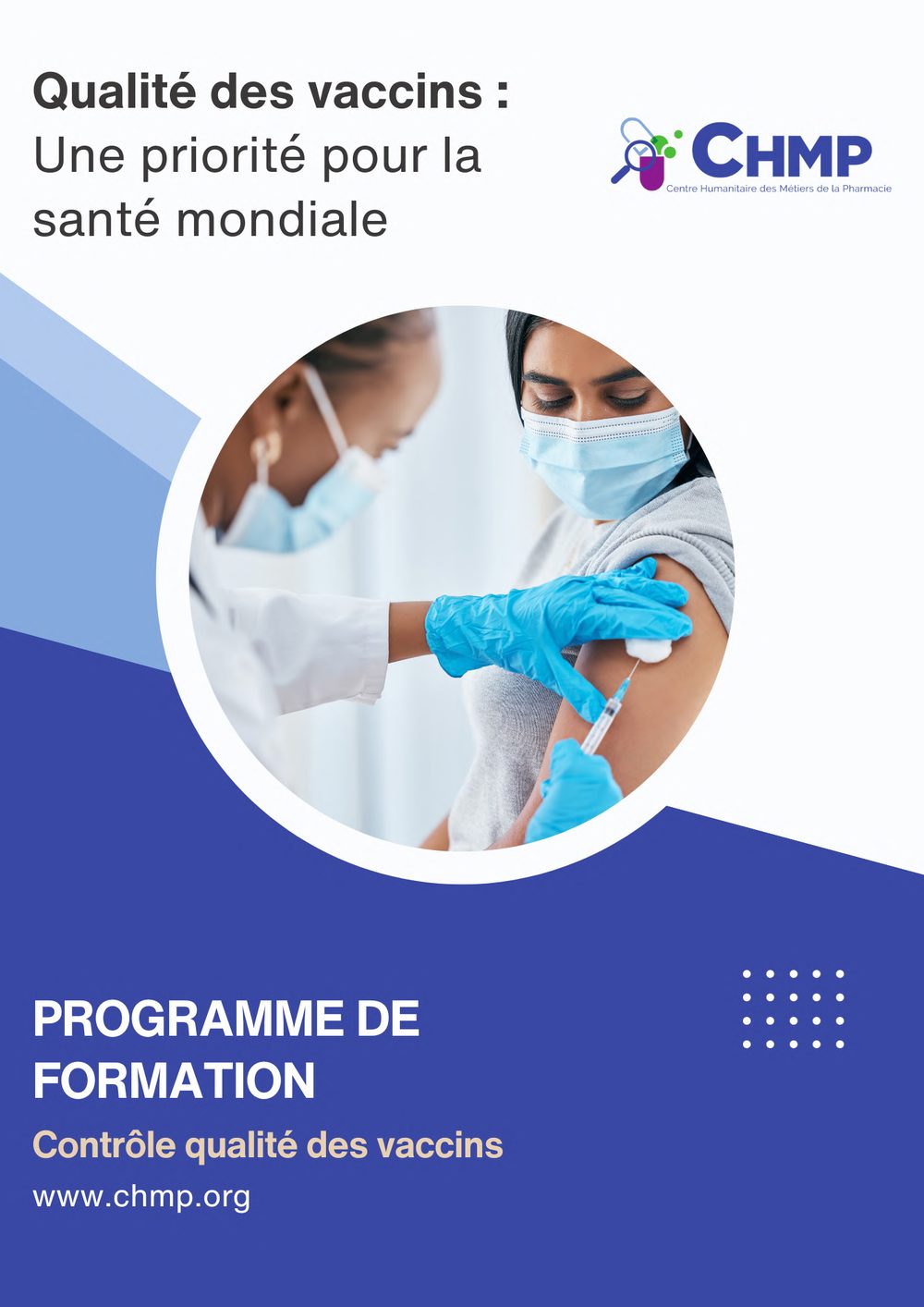
Strengthening skills and practices in vaccine quality control. A priority for global health.
Training objectives
- Carry out tests on vaccine identity, vaccine activity in the laboratory, the stability of vaccine components and microbiological safety.
- Validate vaccine quality-control methods.
- Qualify cleanrooms in compliance with international standards.
Context
Aware of the crucial importance of medicine quality and safety for public health in developing countries (DCs), national medicines control laboratories (NMCLs) are actively engaged in initiatives to strengthen their staff’s skills in the control and quality assurance of health products. In this context, the Centre Humanitaire des Métiers de la Pharmacie (CHMP) offers the opportunity for vaccine-quality-control training in its quality-control laboratory prequalified by the World Health Organization (WHO). This initiative aims to draw on the CHMP’s expertise and to foster an exchange on best practices in vaccine quality control, in order to strengthen the capacities of stakeholders and ensure the quality, efficacy and safety of vaccines in DCs.
The CHMP, created in 1992 by Pharmaciens sans frontières, is a humanitarian and pharmaceutical organisation that operates along three lines of intervention: it is first a control laboratory prequalified by the WHO, it also acts as a leading pharmaceutical training and expertise centre, and finally it operates as a social enterprise headquartered in Clermont-Ferrand. The CHMP is fully committed to carrying out projects that ensure compliance with good pharmaceutical practices throughout the manufacturing and distribution of medicines. It is also committed to promoting the correct use of health products, to ensuring their adequate delivery, and to actively fighting the proliferation of falsified health products.
Objective
This training aims to strengthen skills and practices in vaccine quality control. It places emphasis on the theoretical aspects and on practical situations relating to the control elements routinely carried out on samples of vaccines placed on the market, as well as on vaccines being manufactured. The main aim is to strengthen skills and improve practices in:
- Tests carried out on the following parameters:
- vaccine identity, i.e. the conformity of the vaccine to the expected specifications (in accordance with the product life sheet);
- vaccine activity in the laboratory;
- stability tests of vaccine components;
- microbiological safety (the absence of contamination by foreign micro-organisms).
- Validation of vaccine quality-control methods.
- Cleanroom qualification, in compliance with the international standards UNI EN ISO 14644, ISO 17141, the US Federal Standard and Good Manufacturing Practice (GMP) for the pharmaceutical sector, as well as the European Pharmacopoeia guidelines.
This approach will contribute not only to ensuring vaccine quality and safety, but also to promoting regional collaboration and achieving the sustainable-development goals in the health sector in DCs.
Training content
Prerequisites
The NMCL may provide vaccine samples — notably yellow fever, meningococcal, Covid-19, pentavalent and pneumococcal vaccines — for the practical exercises related to testing and analysis. The documents associated with the samples (technical sheets, analytical methods, previous quality-control results) may also be useful for an in-depth understanding and adequate preparation of the practical activities. The NMCL must ensure that these samples and documents are sent within the required timeframe to allow smooth coordination and adequate planning of the practical activities during the visit.
Day 1 — Theoretical phase on microbiological tests applicable to vaccines
This part of the training consists of an in-depth study of the microbiological tests crucial to assessing vaccine quality. Sterility tests and endotoxin assays, compliant with European Pharmacopoeia requirements, are examined in detail. Participants are introduced to the methods, test protocols and regulatory standards in force in this field.
Days 2 and 3 — Practical phase on microbiological tests applicable to vaccines
This phase aims to put the theoretical concepts into practice by carrying out microbiological tests on the NMCL’s vaccine samples. It involves applying microbiological test methods compliant with European Pharmacopoeia standards, analysing and interpreting the test results to assess sample quality, and identifying the critical points and key steps of the microbiological tests. This immersive step enables participants to develop a practical understanding of vaccine quality-control processes based on real cases.
Day 4 — Theoretical phase on method validation
Method validation is essential to guarantee the reliability of analytical results. During this phase, participants gain an in-depth understanding of the principles of method validation. They are introduced to the key steps of the validation process, the identification of critical parameters and the documentation techniques required for effective implementation.
Day 5 — Practical phase on method validation and cleanroom qualification
The practical phase enables participants to apply the theoretical knowledge acquired. They take part in practical exercises that simulate method validation, including determining detection and quantification limits, performing precision tests and verifying performance and selectivity.
The training also focuses on cleanroom qualification, an essential element in guaranteeing optimal environmental conditions in pharmaceutical production. Participants discover the cleanroom-qualification standards, notably UNI EN ISO 14644. They become familiar with the US Federal Standard and Good Manufacturing Practice (GMP) for the pharmaceutical sector. During the practical phase, they take part in exercises simulating real cleanroom-qualification situations: physical tests, particulate classification in cleanrooms, equipment qualification and microbiological sampling.
Expected results

- Participants’ skills in microbiological testing, method validation and cleanroom qualification are strengthened.
- The skills acquired by participants are immediately usable within the laboratories of their respective countries.
- The links created between vaccine quality-control stakeholders of various origins help to broaden the network around the issue of vaccine quality.
Contact and registration
Pharmaceutical Expertise and Training Division — CHMP
For any information or registration for this training course:
- Phone: +33 (0)4 73 98 24 81
- Email: contact@chmp.org
- Address: 13 rue des 4 Passeports, 63100 Clermont-Ferrand, France
You can also write to us via the Contact page.